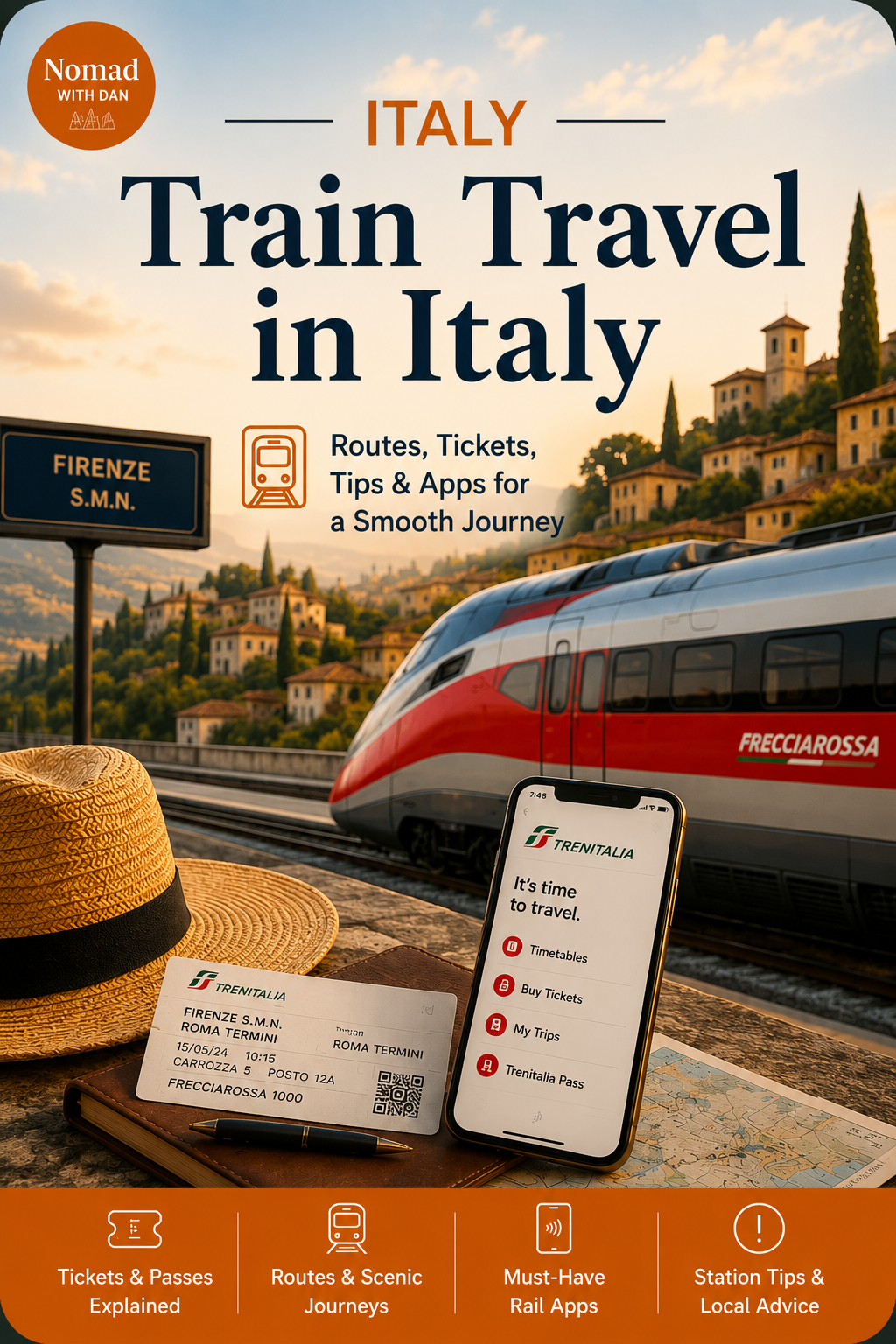
Train Travel in Italy
Everything You Need to Know for a Smooth Journey
Introduction
Italy has one of Europe’s best rail systems. High-speed trains connect major cities in just a few hours, while regional trains make it easy to explore smaller towns and villages.
Whether you’re traveling from Rome to Florence, Venice to Verona, or exploring Tuscany without a car, understanding how Italy’s trains work can save time, money, and stress.
This guide covers everything you need to confidently travel by train in Italy.
Quick Start
If you’re new to train travel in Italy, remember these five tips:
✅ Book high-speed trains in advance for the best prices.
✅ Regional train tickets are usually flexible and don’t require early booking.
✅ Arrive about 20–30 minutes before departure.
✅ Watch the departure board for your platform (“Binario”).
✅ Keep your ticket or QR code ready until you leave the station.
Italy’s Two Main Train Companies
Trenitalia
Italy’s national railway serves nearly every part of the country, from high-speed routes to small regional lines.
Great for:
Major cities
Regional trains
Smaller towns
Airport connections
Italo
Italo operates only high-speed trains on popular routes.
Many travelers compare prices between Italo and Trenitalia before booking because fares are often competitive.
High-Speed vs. Regional Trains
High-Speed Trains
Examples:
Frecciarossa
Frecciargento
Italo
Best for:
Rome
Florence
Milan
Bologna
Venice
Naples
Turin
Verona
Advantages:
Reserved seating
Faster travel times
Comfortable ride
Wi-Fi on most trains
Power outlets
Regional Trains
Regional trains connect smaller destinations throughout Italy.
Perfect for places like:
Pisa
Lucca
Cinque Terre
Arezzo
Cortona
Orvieto
Siena (via bus connection from the station)
These trains are slower but offer excellent value.
When Should You Book?
High-Speed
Book as early as practical.
Advance fares are often significantly cheaper than last-minute tickets.
Regional
Usually no need to book weeks in advance.
Many travelers simply purchase tickets the day they travel.
Buying Tickets
You can purchase tickets:
Online
Official mobile apps
Station ticket machines
Ticket counters
I usually recommend booking directly with the train operator rather than through third-party websites.
Finding Your Train
Inside every station you’ll see large departure boards.
Look for:
Train number
Destination
Departure time
Platform (Binario)
Platforms are often announced 10–20 minutes before departure.
Understanding Platforms
Your ticket may not include a platform number.
Don’t worry.
Simply watch the departure board until your train appears.
Stations in Italy are well organized, and signs are easy to follow.
Ticket Validation
High-Speed Trains
Reserved-seat tickets and most digital high-speed tickets do not require validation before boarding. Simply board the correct train and keep your ticket or QR code available for inspection.
Regional Trains
If you’re traveling on a regional train, be sure you understand whether your ticket requires validation before boarding.
Digital tickets generally activate automatically based on the departure time you selected.
Paper regional tickets purchased from ticket machines often must be validated using the green or yellow validation machines located throughout the station.
If a paper ticket that requires validation is not validated before boarding, you may be subject to a substantial fine—even if you’ve already paid for the ticket.
Always follow the instructions provided with your ticket, as validation rules can change.
Ticket Inspections & Identification
Ticket inspections are common on both high-speed and regional trains. During your journey, a conductor will typically scan your ticket or QR code, so keep it easily accessible until you reach your destination.
If you’re visiting Italy from outside the European Union, I recommend carrying your original passport with you while traveling rather than relying on a photocopy or a photo on your phone. Italian police or other authorities may ask you to provide identification during train travel or elsewhere, and your original passport is the primary document that establishes both your identity and your lawful entry into Italy.
I recommend carrying your passport in a secure cross-body bag, money belt, or another place that’s always with you rather than leaving it in your hotel room or packed in your luggage.
Learn more about passport requirements:U.S. Embassy & State Department guidance for travel to Italy
💡 Travel Tip: Before boarding, make sure you have three things easily accessible: your train ticket, your passport, and your seat assignment (if traveling on a high-speed train). Having them ready makes ticket inspections quick and stress-free.
There are no airline-style baggage fees.
You’ll simply carry your luggage onto the train yourself.
Storage is usually available:
Above your seat
At the ends of train cars
Between seat rows on some trains
Pack light enough that you can comfortably lift your own luggage.
First Class vs. Standard
Both are excellent.
Standard Class is clean, comfortable, and perfectly suitable for most travelers.
First Class generally offers:
Larger seats
More legroom
Quieter atmosphere
Complimentary snacks or drinks on some services
Best Rail Apps
I recommend downloading these before your trip:
Trenitalia
Italo
Google Maps
Rome2Rio
These make planning and tracking your journey much easier.
Common Routes
Popular travel times include approximately:
Rome → Florence: 1½ hours
Florence → Bologna: 40 minutes
Bologna → Verona: 50 minutes
Verona → Venice: about 1 hour
Milan → Florence: about 2 hours
Rome → Naples: about 1 hour 10 minutes
Frequently Asked Questions
Should I buy a rail pass?
For most travelers visiting only Italy, individual tickets are usually the better value than a rail pass.
Is Wi-Fi available?
Most high-speed trains offer Wi-Fi, though the quality can vary.
Are trains safe?
Yes. Italy’s trains are generally very safe. As in any busy transportation hub, stay aware of your belongings in crowded stations.
Can I bring luggage?
Absolutely. There are no checked bags—just bring what you can comfortably handle yourself.
Dan’s Tip
One of my favorite things about traveling in Italy is letting the train do the work. Instead of worrying about traffic, tolls, or parking, I can relax, enjoy the scenery, and arrive right in the heart of the next city. For itineraries that include destinations like Rome, Florence, Bologna, Verona, or Venice, I often recommend trains over renting a car.